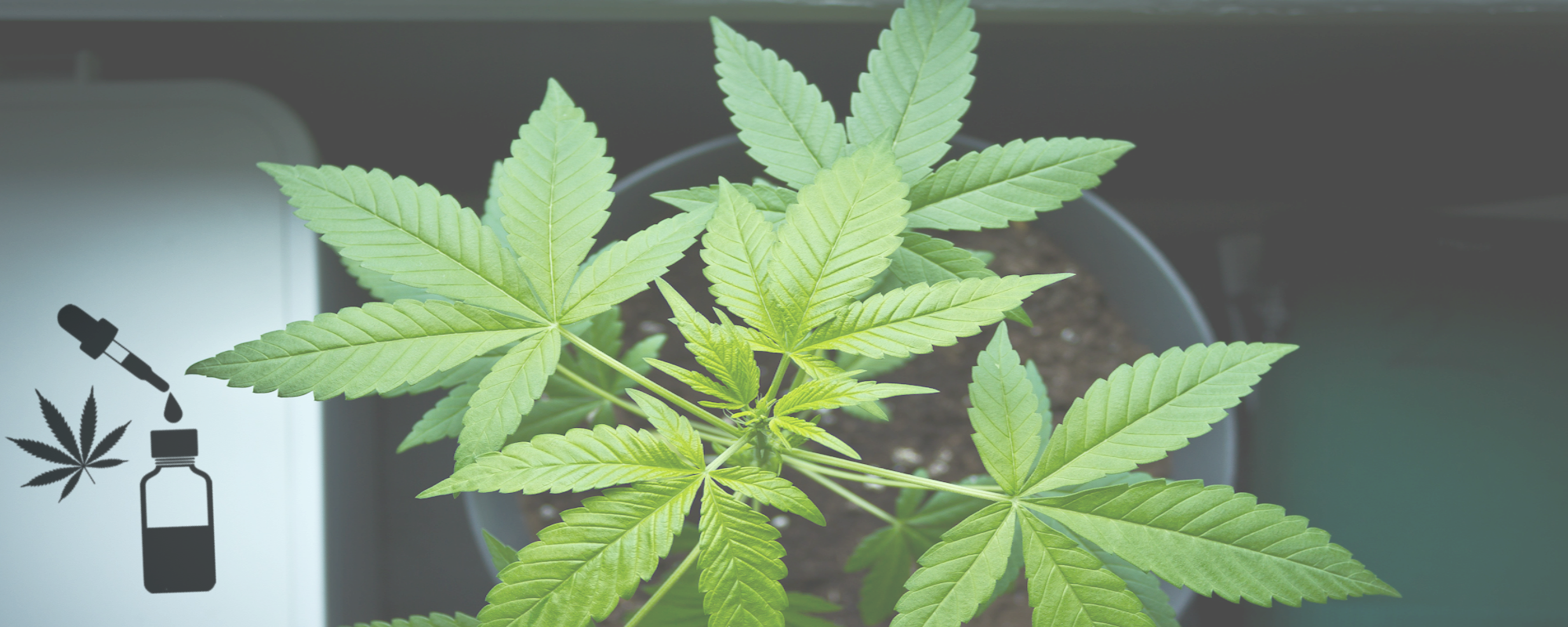


The header contains images of the CBD plant itself (by mohamed_hassan) and a vial of a CBD oil tincture (by Sean E). These images were chosen because the relationship between the by-product of the plant and the plant itself doesn’t always show an obvious relation between the two. There is still much misinformation that exists out on the web that doesn’t clarify the difference between the Cannabis plant and the CBD plant because of one condition: They look the same! There will be those who would see the distinct star-shaped leaf and become disheartened because of the bad connotation that lies behind Marijuana and its legal status. However, CBD is completely legal to use in all 50 states in the U.S. By providing an image of a CBD Oil tincture, it provides an idea of the many different forms CBD comes in ranging from the plant itself, oils, edibles, and much more.
The images were created using a photo editing service called Pixlr which felt very familiar to the Photoshop software I had used in Photography class in my high school. The editing itself was simplistic for the image I had envisioned required three things: cropping, rotating, and increasing transparency. I took the background image of the CBD plant and increased its original size and widened its margins in order to fit the dimensions of my webpage. I then took the second image of the oil tincture, decreased its size, and rotated it to fit towards the side of the CBD plant.
The sourcing of the images differs between the two for the CBD plant was taken from a website called Flickr and the oil tincture was sourced from Pixabay through google images. In order to use them for the website, it was essential to filter for non-commerical use. After using the filter both images provided the licensing information (Pixabay’s licensing and the other through creative commons).
In the article Articles for Computational Culture by Lev Manovich, he points out that the use of layering has changed the way artists can view and create images. Manovich states, “Layers change how a designer or an illustrator things about images. Instead of working on a single design, with each change immediately (and in the case of physical media such as paint or ink, irreversibly) affecting this image, she now works with a collection of separate elements. She can play with these elements, deleting, creating, importing and modifying them, until she is satisfied with the final composition – or a set of possible compositions that can be defined using Layer Groups.” With this addition to editing software platforms like Photoshop and others, it was the most essential for the creation of my header and couldn’t have been as seamless looking without the tool. The ability to rotate and change the transparency between my two images was so much simpler than trying to combine both images on the same layer.
Because of the Pixels: On the History, Form, and Influence of MS Paint by Patrick Davidson, he describes how images created through MS Paint are made up of jagged looking pixelation on a single layer bitmap with mouse functionality unique to the MS paint platform. Davidson states, “The visual dimensions of resolution and bit-depth and the physical experience of using a mouse are therefore the hallmarks of ‘an authentic computer aesthetics’; they produce the visible traces of techniques and devices unique to digital computers.” This process was somewhat different from the process I used to create the header image because the header on my website didn’t require me to physically draw anything to create the image. It was similar because the multi-purposes that the mouse had in Pixlr was helpful with cropping, moving, rotating, and resizing the image.
References
“cbd-oil-hemp-cannabis-medical” by mohamed_hassan
License: Pixabay License
Free for commercial use
No attribution required
License: Attribution-NonCommercial-ShareAlike 2.0 Generic (CC BY-NC-SA 2.0)
 NJ CBD Central